20 February 2022
On the Southern California Beaches page photo #5481 was added to the Wayfarers Chapel section. Also the Cabrillo Beach section was added in its entirety.
5 July 2021
Added picture #5143 to the Misc. Other Pictures page.
5 July 2021
Added picture #5143 to the Misc. Other Pictures page.
Astronomy
This page shows some of the astronomy pictures I have taken over the years. I have defined "Astronomy" for this as those pictures of the sky were taken primarily for the view of the stars, sun, moon, etc. Sunset pictures, that were primarily taken to show the sunset against a landscape view, are NOT included in this section. They will be found under the location/trip at which they were taken.
Lunar Eclipse
The following two pictures were taken of the partial lunar eclipse that occurred in August of 2026. At the maximum amount of the eclipse about 96.3% of the Moon’s disk is within Earth’s umbra (the darkest part of the shadow). This eclipse was part of Saros 138, which includes a series of eclipses occurring approximately every 18 years. The previous eclipse in this series was on August 16, 2008, and the next will be on September 7, 2044.
Lunar eclipses have been viewed as significant events across various cultures, often associated with supernatural beliefs or omens. For example, in some Native American traditions, lunar eclipses were seen as a time for reflection and spiritual renewal, while in Christianity, they are mentioned in the context of significant biblical events, such as the crucifixion of Jesus, where the Moon is said to have turned to blood. Many cultures interpreted lunar eclipses as signs from the divine or as moments to engage in prayer and introspection.
The type and length of a lunar eclipse depend on the Moon's proximity to the lunar node. In contrast with elusive and short-lasting solar eclipses, lunar eclipses can be observed from anywhere on the night side of Earth and often last for an hour or longer. Lunar eclipses are safe to observe without eye protection. Lunar eclipses cause the Moon to appear orange or red. This occurs because when the Moon passes through the Earth's umbra, any sunlight that reaches the Moon must first pass through the Earth's atmosphere. The resulting Rayleigh scattering removes short-wavelength colors such as violet and blue from the light before it reflects back off the lunar surface and is observed on Earth.
Types of Lunar Eclipses
Penumbral Lunar Eclipse
A penumbral lunar eclipse occurs when Earth's silhouette partially blocks the Sun in the lunar sky but does not occlude it completely, ensuring some sunlight can still reach the Moon directly. The designation refers to the Moon being partially inside the penumbra, which describes the region of any shadow that is cast by a light source which is not collimated and has a non-zero angular diameter. A penumbral eclipse is designated as a total penumbral eclipse if the Moon lies exclusively inside of the penumbra. Penumbral eclipses are observed from Earth as a subtle dimming of the lunar surface. Of all lunar eclipses, approximately one-third are penumbral eclipses; of those, only 3% are total penumbral eclipses.
Partial Lunar Eclipse
A partial lunar eclipse refers to the Moon lying partially inside of the umbra, where the relative size of the Earth in the lunar sky allows it to block the Sun entirely. During a partial eclipse, the dark region covered by the umbra will appear much more distinct than the penumbral dimming. The Moon's average orbital speed is about 2,300 mph, or a little more than its diameter per hour, so totality may last up to nearly 107 minutes. Nevertheless, the total time between the first and last contacts of the Moon's limb with Earth's shadow is much longer and could last up to 236 minutes. (The eclipse shown in these pictures is this type.)
Total Lunar Eclipse
When the Moon's near side entirely passes into the Earth's umbral shadow, a total lunar eclipse occurs. Just prior to complete entry, the brightness of the lunar limb—the curved edge of the Moon still being hit by direct sunlight—will cause the rest of the Moon to appear comparatively dim. The moment the Moon enters a complete eclipse, the entire surface will become more or less uniformly bright, being able to reveal stars surrounding it. Later, as the Moon's opposite limb is struck by sunlight, the overall disk will again become obscured. This is because, as viewed from the Earth, the brightness of a lunar limb is generally greater than that of the rest of the surface, due to reflections from the many surface irregularities within the limb: sunlight striking these irregularities is always reflected back in greater quantities than that striking more central parts, which is why the edges of full moons generally appear brighter than the rest of the lunar surface. This is similar to the effect of velvet fabric over a convex curved surface, which, to an observer, will appear darkest at the center of the curve. It will be true of any planetary body with little or no atmosphere and an irregular cratered surface (e.g., Mercury) when viewed opposite the Sun.. The Moon does not completely darken as it passes through the umbra because of the refraction of sunlight by Earth's atmosphere into the shadow cone; if Earth had no atmosphere, the Moon would be completely dark during the eclipse. The reddish coloration arises because sunlight reaching the Moon must pass through a long and dense layer of Earth's atmosphere, where it is scattered. Shorter wavelengths are more likely to be scattered by the air molecules and small particles; thus, the longer wavelengths predominate by the time the light rays have penetrated the atmosphere. Human vision perceives this resulting light as red. This is the same effect that causes sunsets and sunrises to turn the sky a reddish color. An alternative way of conceiving this scenario is to realize that, as viewed from the Moon, the Sun would appear to be setting (or rising) behind Earth. The amount of refracted light depends on the amount of dust or clouds in the atmosphere; this also controls how much light is scattered. In general, the dustier the atmosphere, the more that other wavelengths of light will be removed (compared to red light), leaving the resulting light a deeper red color. This causes the resulting coppery-red hue of the Moon to vary from one eclipse to the next. Volcanoes are notable for expelling large quantities of dust into the atmosphere, and a large eruption shortly before an eclipse can have a large effect on the resulting color.

Picture Number: CM1_0809
Date: August 2026
Camera: Nikon D7100
ISO: 3200 Shutter Speed: 0.4 sec
F-Stop: f/6 Lens:260 mm

Picture Number: CM1_0810
Date: August 2026
Camera: Nikon D7100
ISO: 3200 Shutter Speed: 0.4 sec
F-Stop: f/6.3 Lens: 300 mm
Star Fields
The following pictures are general star-field pictures. They were taken at Joshua Tree National Park. The light you see in the lower part of pictures two and three is the glow from the city of Palm Springs. The line you see in the lower-right part of picture number two is probably a plane's lights that were captured during the time exposure.

Picture Number: CM1_0072
Date: October 2016
Camera: Nikon D7100
ISO: 4000 Shutter Speed: 30 sec
F-Stop: f/5.6 Lens: 18 mm

Picture Number: CM1_0059
Date: October 2016
Camera: Nikon D7100
ISO: 2500 Shutter Speed: 30 sec
F-Stop: f/5.6 Lens: 18 mm

Picture Number: CM1_0065
Date: October 2016
Camera: Nikon D7100
ISO: 2000 Shutter Speed: 30 sec
F-Stop: f/5.6 Lens: 18 mm
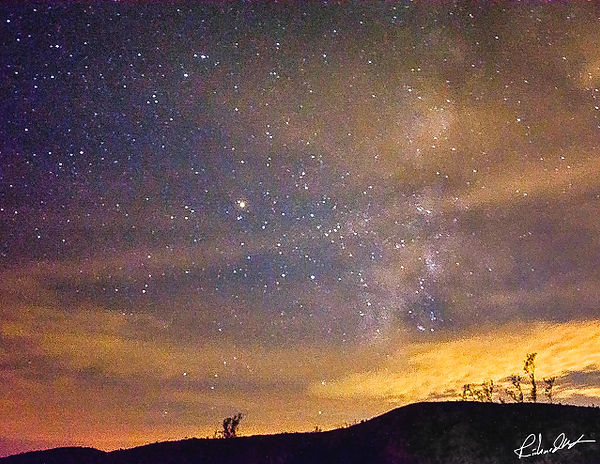
This is another star field picture. However this one was taken shortly AFTER sunset. Thus you can see much more of the clouds that were in the sky that night.
Picture Number: CM1_0025
Date: October 2016
Camera: Nikon D7100
ISO: 1600 Shutter Speed: 30 sec
F-Stop: f/5.6 Lens: 20 mm
Moon Sets
The following pictures are of the moon setting. They were taken in Death Valley during a trip there in March 2016. The first two pictures show the moon approaching moon-set while the sun itself had yet to completely set. The second set of pictures (taken on a different day) were taken just as the moon was setting.

Picture Number: CM1_0007
Date: March 2016
Camera: Nikon D7100
ISO: 200 Shutter Speed: 1/250 sec
F-Stop: f/5.6 Lens: 140 mm

Picture Number: CM1_0002
Date: March 2016
Camera: Nikon D7100
ISO: 200 Shutter Speed: 1/250 sec
F-Stop: f/5.6 Lens: 140 mm

Picture Number: CM1_0055
Date: March 2016
Camera: Nikon D7100
ISO: 2800 Shutter Speed: 1/60 sec
F-Stop: f/5.6 Lens: 140 mm

Picture Number: CM1_0058
Date: March 2016
Camera: Nikon D7100
ISO: 1800 Shutter Speed: 1/60 sec
F-Stop: f/5.6 Lens: 140 mm